

Naoshima New Museum
of Art Pre-Talk Vol.3
Asian Contemporary Art, Benesse Art Site Naoshima, and the Naoshima New Museum of Art
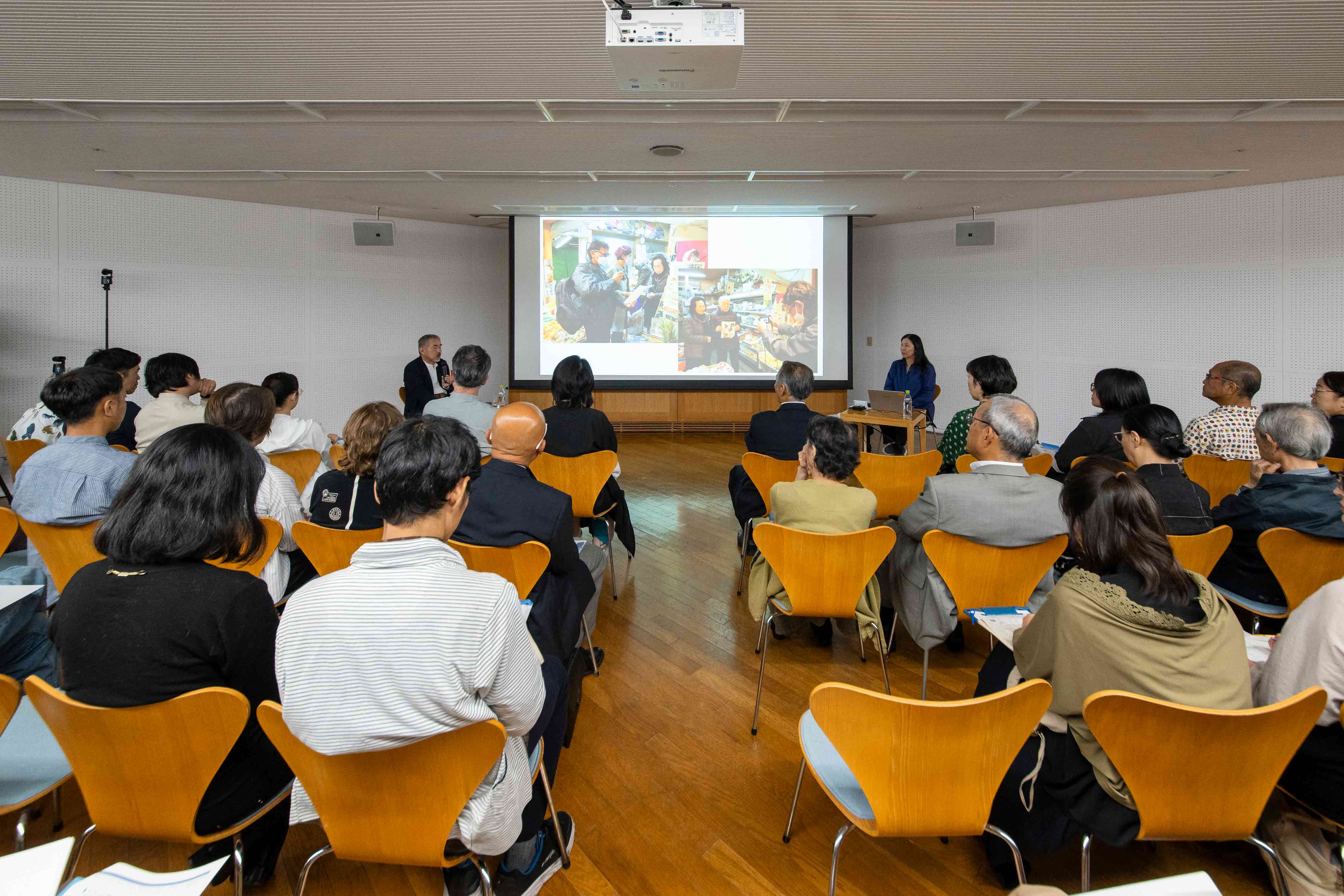
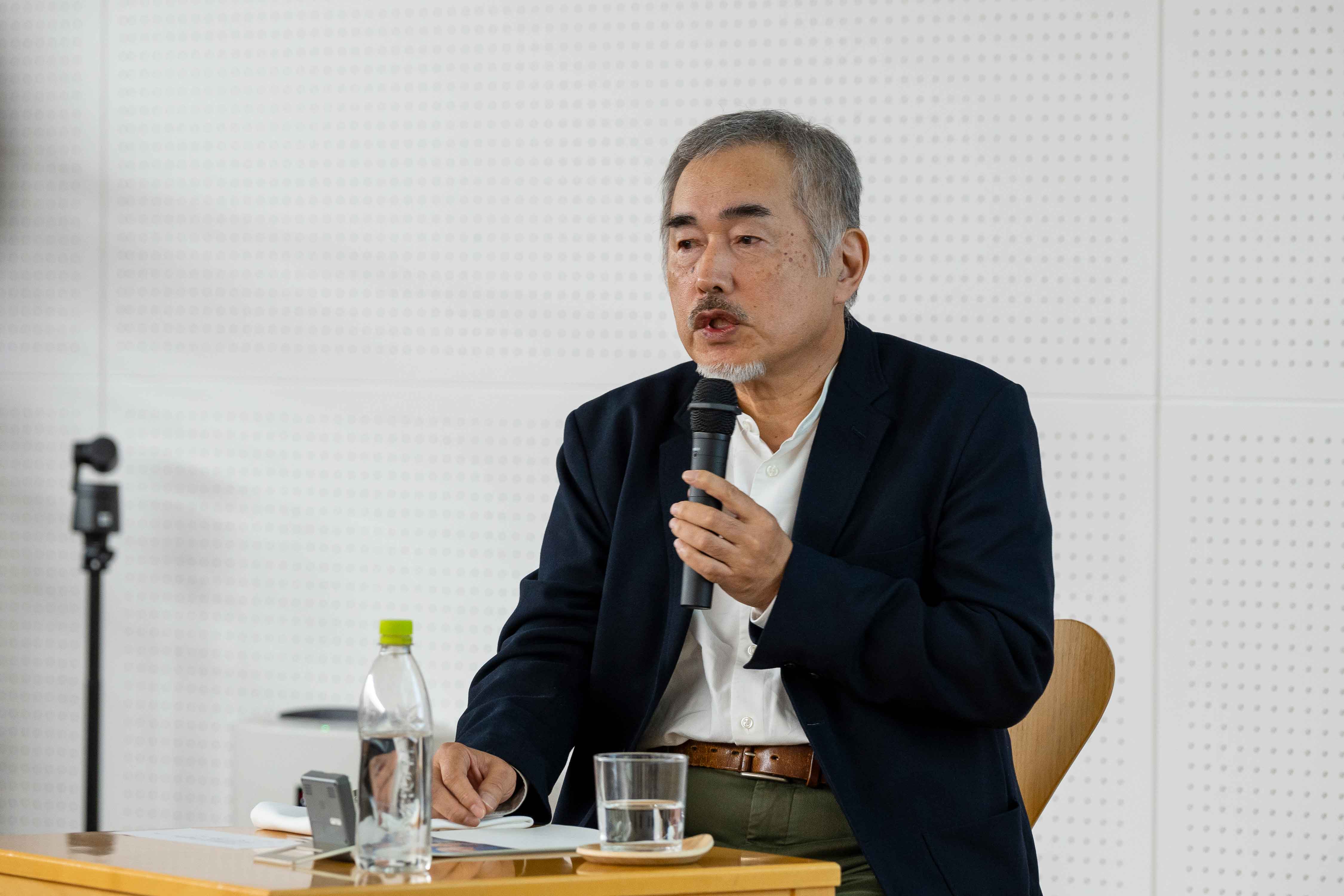
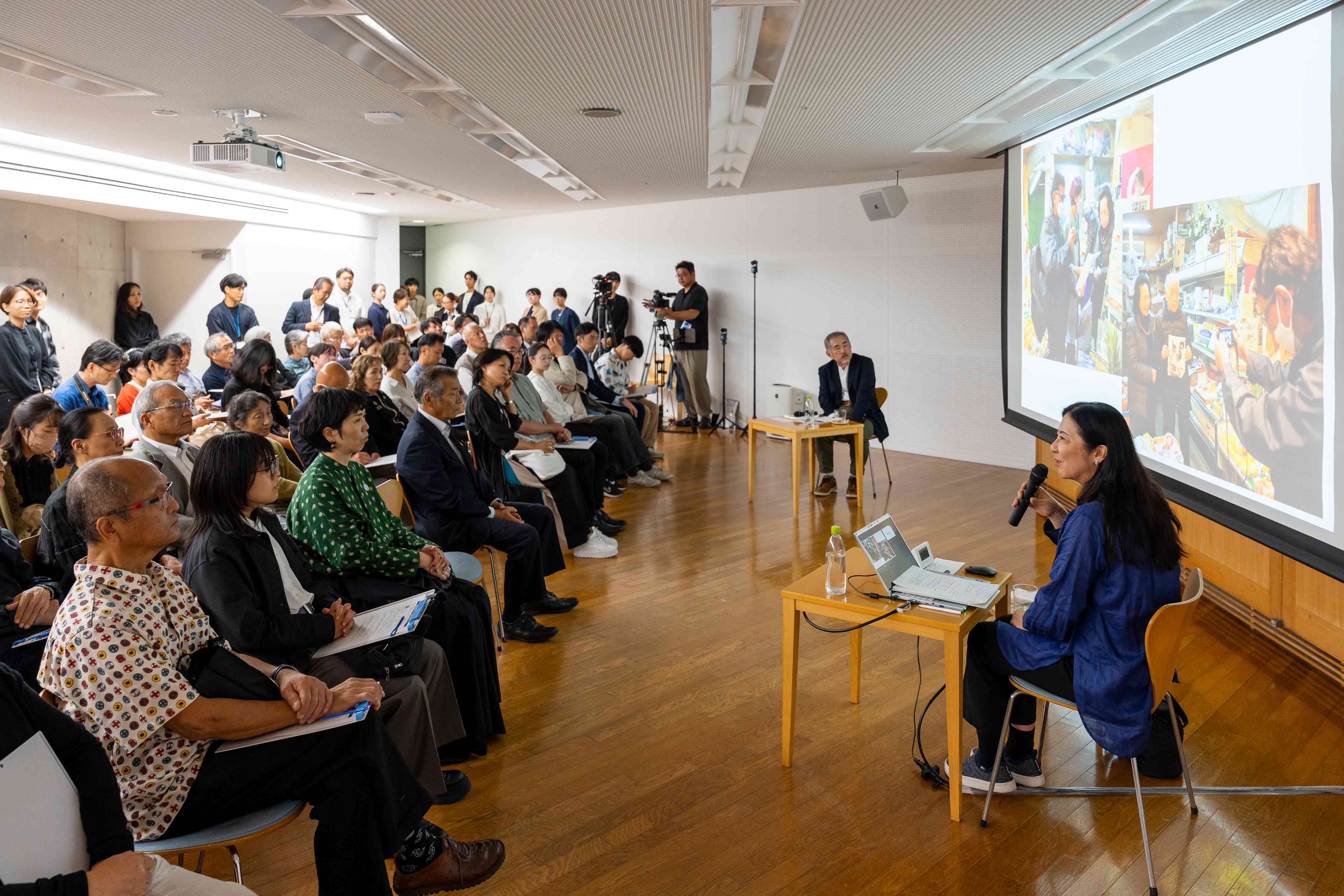
On October 12, 2024, at the Benesse House Lecture Room, we held the third in a series of pre-events leading up to the opening of the Naoshima New Museum of Art. We welcomed Director Masahiro Ushiroshoji of the Kitakyushu Municipal Museum of Art for a talk and discussion. Taking the historical trajectory of Asian contemporary art as our theme, we reflected on its development and engaged in open conversation.
Naoshima New Museum
of Art Pre-Talk Vol.3
Asian Contemporary Art, Benesse Art Site Naoshima, and the Naoshima New Museum of Art
On October 12, 2024, at the Benesse House Lecture Room, we held the third in a series of pre-events leading up to the opening of the Naoshima New Museum of Art. We welcomed Director Masahiro Ushiroshoji of the Kitakyushu Municipal Museum of Art for a talk and discussion. Taking the historical trajectory of Asian contemporary art as our theme, we reflected on its development and engaged in open conversation.
Miki Akiko:
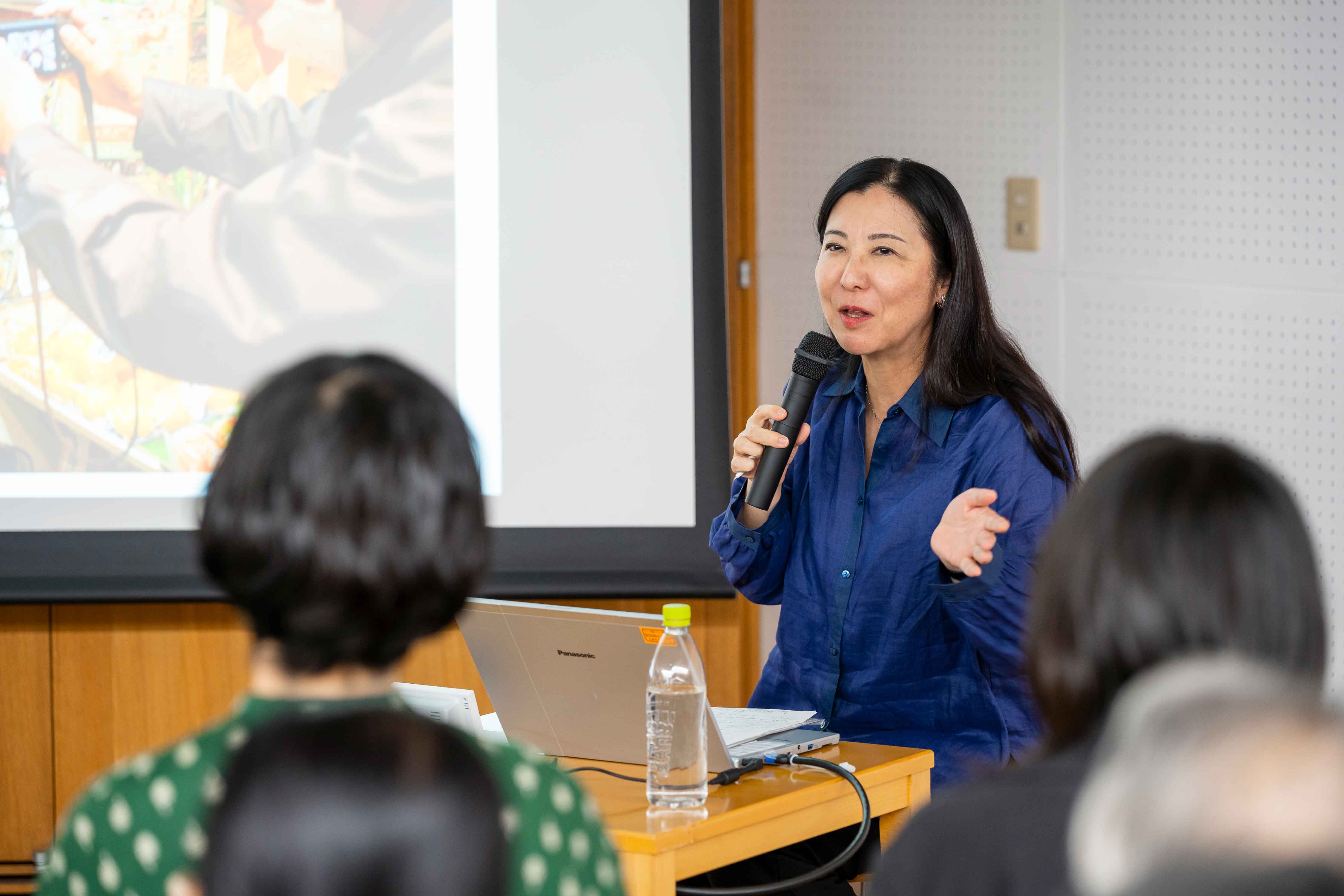
My name is Akiko Miki, and I serve as Director of the Naoshima New Museum of Art. The theme of the third Naoshima New Museum of Art pre-event is "Asian Contemporary Art, Benesse Art Site Naoshima, and the Naoshima New Museum of Art." As the Naoshima New Museum of Art is planned to focus on Asian contemporary art, I hope that today, together with Masahiro Ushiroshoji, Director of the Kitakyushu Municipal Museum of Art, we can take a brief look back at the historical trajectory of Asian contemporary art.
First, I would like to say a few words about the Naoshima New Museum of Art. From the 1995 opening of Benesse House Museum, known at the time as the Naoshima Contemporary Art Museum, through to the Naoshima New Museum of Art, I believe there is no other place in the world where so many museums and art facilities are concentrated on a single island. The Naoshima New Museum of Art is the tenth art facility, designed by Tadao Ando, at Benesse Art Site Naoshima and our vision goes beyond simply adding another museum. We hope it will serve as one of the driving forces behind the further development of this collection of museums as a unified whole. Building on Benesse Art Site Naoshima's founding philosophy of "the harmony of nature, art, architecture, and community," we aim to foster diverse perspectives and values.
Regarding the exhibitions, the focus to date has largely been on permanent works, but going forward, we plan to operate as a more dynamic museum by also featuring special exhibitions. As for how frequently we rotate the displays, rather than changing everything every two or three months, as an urban museum might, we envision a model in which permanent works remain in place while certain areas are refreshed on a cycle of two to three years, and others on a roughly annual basis. The thinking behind this policy of varying the exhibition cycle by gallery space is that each visit will bring small but perceptible changes, prompting new discoveries and, we hope, encouraging people to return again and again.
Regarding the theme of today's pre-event "Contemporary Asian Art and Benesse Art Site Naoshima," I want to emphasize that this is not a case of Asian art suddenly becoming a focus in recent years. Rather, there is a long-standing relationship between Benesse Art Site Naoshima and artists from across Asia that spans years and into the present day.
Our engagement with Asian artists dates back to 1995, the year the company changed its name from Fukutake Publishing to Benesse Corporation, and around the time of the "TransCulture" exhibition at the Venice Biennale. At the time, the center of the international art world was Europe and North America, and the Venice Biennale was dominated by established Western artists. Against that backdrop, "TransCulture" drew considerable attention for presenting works by artists from regions outside the Western mainstream, from Asia, Africa, and elsewhere. The exhibition included works by Cai Guo-Qiang and Takashi Murakami. The Benesse Prize was established that same year, alongside "TransCulture," with recipients selected from among the artists participating in the exhibition.
The first recipient was Cai Guo-Qiang. A homecoming exhibition reporting on "TransCulture" was held at Benesse House Museum, and subsequently, in 1998, Cai produced the work Cultural Melting Bath: Project for Naoshima. From 2016 onward, the Benesse Prize shifted its venue from the Venice Biennale in Europe to the Singapore Biennale in Asia. The first recipient following the move to Singapore, the eleventh recipient overall, was Pannaphan Yodmanee. That award-winning work has been exhibited at Fukutake House on Shodoshima, and at Benesse House Museum, with the form of the piece evolving incrementally with each new setting. It will be presented in a further evolved form at the Naoshima New Museum of Art as well. The twelfth recipient was Amanda Heng. The thirteenth recipient, Haegue Yang, co-created Ring of Fire: Solar Yang & Lunar Weerasethakul with Apichatpong Weerasethakul; the work can currently be experienced at Matabe in the Honmura district. Through the Benesse Prize, we have built a collection of Asian contemporary art while also deepening our relationships with the artists themselves.
At the aforementioned Fukutake House on Shodoshima, the second-floor space was used as an Asia Gallery, primarily from 2019, to present Benesse Art Site Naoshima's collection of Asian contemporary art. Works on display included video pieces from the collection by Ai Weiwei, as well as newly commissioned works by Asian artists such as Lee Kit. In a sense, the Asia Gallery at Fukutake House can be said to have been the catalyst that shaped the direction of the Naoshima New Museum of Art.
Looking back at the international art scene, following the end of the Cold War structure in 1989, the currents of globalism and multiculturalism began to rise. Within an international art world that had long been centered on Europe and North America, attention shifted rapidly toward art from other regions: Asia, Africa, and beyond. From the 1990s onward, museums dedicated to Asian contemporary art were established around the world. The Fukuoka Asian Art Museum, whose founding was due in part to today's speaker Masahiro Ushiroshoji, opened in 1999. The Queensland Art Gallery in Australia launched the "Asia Pacific Triennial (APT)" in 1993, focusing on Asian contemporary art. The Singapore Art Museum followed in 1996, then in the 2000s came the National Gallery Singapore in 2015, and M+ in Hong Kong in 2021. The number of museums engaged in the comprehensive research, collection, preservation, and dissemination of art from the Asian region has grown considerably.
That said, while the Naoshima New Museum of Art does engage with contemporary Asian art, its approach differs from that of such institutions. It operates firmly within the guiding principles of Benesse Art Site Naoshima: the harmony of art, architecture, nature, and community; regional revitalization through art; and the creation of a place for reflection on the idea of "well-being." With these principles as its foundation, the museum intends to focus on and collaborate with artists from Asia, a region with which it shares deep historical and cultural ties.
One of the reasons the Naoshima New Museum of Art is centered on Asian contemporary art lies in the wishes of Honorary Chairman Soichiro Fukutake, who felt that Japan lacks museums where one can reliably encounter major works by Asian artists, including Japanese artists, and wanted to create such a place on Naoshima. This also speaks to the importance of reflecting on our own history and culture, and within the context of this "museum complex," it represents an effort both to clarify the distinct character of each venue and to create spaces where visitors can engage with expressions born from a wider range of cultural and historical backgrounds.
Asian contemporary art began attracting attention in the 1980s and 90s, and in Japan, something of an "Asia boom" took hold in the 90s. Korean contemporary art had been introduced in the 80s, but it was in the 90s that contemporary art from many other parts of Asia—China, Taiwan, Thailand, Indonesia, Singapore, India, and beyond—began to be presented more widely, and our own knowledge and networks expanded accordingly. The Fukuoka Art Museum had been paying close attention to Asian contemporary art since the early 1980s. With that, let us now turn the floor over to Masahiro Ushiroshoji.
Ushiroshoji Masahiro:
I am currently serving as Director of the Kitakyushu Municipal Museum of Art, but the basis for what I will be sharing today is my involvement with Asian modern and contemporary art at the Fukuoka Art Museum, where I began my career as a curator, and the fact that during the 1990s I was working there while simultaneously working toward the establishment of the Fukuoka Asian Art Museum. For that reason, I would like to begin with the 1990s. My view is that the various issues and characteristics that define Asian contemporary art today are largely rooted in developments that took place in the 90s and have continued through to the present.
The world's first contemporary art exhibition focused specifically on Asia was held at the Fukuoka Art Museum in 1980 I was involved in that exhibition myself, as a young curator in my early twenties. As for what Asian art looked like before the 1990s—paintings in frames, bronze sculptures, stone and wood sculptures placed on pedestals, things like that—the mainstream of Asian art in the 1980s was, broadly speaking, what you might picture when you think of modern art. Then, from just before the 1990s, the nature of art began to change rapidly. For example, a work by Thai artist Montien Boonma titled Stories from the Farm, a spatial installation using everyday objects from daily life, is a representative example of the period. And Singaporean artist Tang Da Wu presented an exhibition with tonic drinks as its theme. The backstory is that tonics were once made from rhinoceros horn, and the resulting poaching devastated rhinoceros populations to the point where they were nearly wiped out across Asia. Tang Da Wu also employed performance, singing and dancing himself, as a mode of expression.
The Asian contemporary art exhibition, first held in 1980 continued on a recurring basis every five years. The theme of "the Fourth Asian Art Exhibition" was "Realism as an Attitude." Not realism in the stylistic sense of faithful representation, but realism in the sense of how one gives expression to the reality that surrounds us: an "attitude" directed toward reality itself.
In this "Fourth Asian Art Exhibition," Singaporean artist Lee Wen painted his own body yellow, an act that deliberately emphasized the notion of the "yellow race," and during the exhibition's run created a work on the floor using rice, while also taking his performance out into the streets of the city.
The work Pintado by Filipino artist Roberto Feleo—"Pintado" being a term for the Filipino people—speaks to the country's history as a Spanish colony. "Pintado" is the Spanish word for "painted," and it was the name Spanish colonizers gave to the indigenous people who covered their bodies in tattoos, calling them "painted people." The work retells the story of the hardships endured under colonial rule, their own history, from the perspective of the Filipino people themselves.
From the late 1980s through the 1990s, Asian art entered a period of profound transformation, shifting from work in the Modernist tradition toward what we now call contemporary art and contemporary modes of expression. Concretely speaking, the subjects changed. Rather than aesthetic concerns, social and political themes became increasingly prominent: a focus on the reality of everyday surroundings, or what might be called a "gaze" directed toward one's own history. The forms of expression changed as well. The oil painting in a frame gave way to installation work, and there was an overwhelming increase in temporary spatial constructions fitted to specific sites, as well as performance using the artist's own body. Materials changed, too. Previously, fine art had been constituted by privileged materials such as costly pigments, marble, and bronze, but artists began making work from ordinary, everyday objects close at hand. I asked a number of artists about this at the time, and they told me that existing forms of expression were simply not adequate to convey social and political themes, or the realities of their immediate surroundings, and so they sought to communicate what they felt by adopting new forms like installation. So, the 1990s were a decade in which everything changed, from subject matter to form.
Behind these sweeping changes lay Asia's economic development. Where previously the social structure had consisted largely of a vast majority of the poor and a small, concentrated wealthy elite, economic development gave rise to an urban middle class. That development brought with it a brighter side, in the form of growth and urbanization, but also a shadow side, in the form of environmental destruction and pollution. Japan had traveled a similar path, and what had happened there—the dissolution of traditional rural community structures, people moving to cities, the fragmentation of families into nuclear units—was now occurring across other parts of Asia as well.
There was also the backdrop of dramatic political upheaval. The fall of the Berlin Wall in 1989 and the collapse of the Soviet Union sent ripples across Asia, sparking a wave of democratization, though a backlash emerged simultaneously. The Tiananmen Square incident in China was, I think, one of the most symbolic expressions of government suppression and repression directed against democratic movements. China, at the time, was introducing a market economy that came to be known as "red capitalism," and you are all well aware of where that has led. Asia was thus undergoing transformation at the level of political systems. And while the internet did not yet widely exist, advances in information and communications technology made satellite television accessible across Asia. Where young women's fashion had previously varied by country, Japanese "gyaru" fashion began appearing in Indonesia as well, and styles gradually became more uniform. Meanwhile, advances in transportation fueled the flow of goods, information, and people, and the lives of those living across Asia were overtaken by sweeping change. How to respond to and adapt to that change underlay the shifts we saw in Asian art during this period.
Let me say a few words about the situation of contemporary art in China. In the early 1980s, after a period of complete closure, a century's worth of information about art from around the world flooded in all at once, and Chinese artists of the time found themselves in a state of some confusion as they absorbed it all and began experimenting with various forms of expression. In 1985, what became known as the '85 Art Movement emerged, and radical, avant-garde expression spread widely. At the center of that activity was a group called Xiamen Dada.
In 1989, an exhibition of Chinese contemporary art, which had undergone dramatic change throughout the 1980s, was held at the National Art Museum of China in Beijing. The work presented by artist Lü Shengzhong involved gathering large numbers of human figures and burning them. In China, it is said that when the soul separates from the body, illness follows. The work was built around the theme of the soul of China as a nation having separated from the body of China, and of using small red human figures to call that soul back and heal the nation's sickness.
Moving from the 1990s into the 2000s, as I traveled across Asia observing art, I began to sense a growing interest in communication among Asian artists. Of course, artistic expression is in itself a form of communication, but I mean something beyond that: works that actively provoked communication through their making and viewing, and that encouraged audience participation, became increasingly prevalent. I believe the key words for understanding Asian art from the 1990s through the 2000s are "communication," "collaboration," and "community." Community refers to shared groups and local society, with the family perhaps being the smallest unit. There was a growing body of work that, through collaboration as a method of making and developing art together with others, actually generated communication or sought to restore it. That recognition of these key words informed our decision to title the inaugural exhibition of the Fukuoka Asian Art Museum, the 1st Fukuoka Asian Art Triennale, Communications: Channels for Hope. Amanda Heng, the twelfth Benesse Prize recipient Ms. Miki mentioned earlier, exhibited at this Triennale, with work themed on her relationship with her mother.
Let me share a few anecdotes about individual works by Asian artists. A Filipino artist once asked me to collect 50,000 toothbrushes. Gathering toothbrushes, both used and in use, proved extraordinarily difficult. Simply approaching a woman you don't know and asking for her toothbrush is the kind of thing that might get you arrested. Even when you explained that it was needed for a work of art, the response was invariably: how could a toothbrush be art? The process of collecting toothbrushes through exactly these kinds of exchanges was, for the artist, the essential thing. The fleeting "toothbrush community" that came into being through that process was the work the artist wanted to create. In the end, only 25,000 were collected.
There was also an artist who had lived in a village in China for around ten years and painted portraits of the villagers, but not by painting alone. The villagers painted too, with artist and villager painting each other in conversation, so that communication was generated through the act of portraiture itself.
I would also like to mention a Pakistani female artist, Aisha Khalid. Pakistan has a tradition of miniature painting, and in the 1990s, at a national art school, female students studying miniature painting in that tradition were actively producing miniature works on contemporary themes. Aisha Khalid is the most prominent figure from that movement. Her work Birth of Venus depicts, in miniature, an Asian Venus curled like a fetus within a round circle. This is quite unlike Botticelli's Western Venus, who stands displaying her nude body with pride. I think it is a work that symbolically captures the situation in which Muslim women were placed.
Finally, I would like to speak about Navin Rawanchaikul, an artist who works between Fukuoka and Thailand. Directors do not typically organize exhibitions themselves, but when I was offered the position of Director of the Kitakyushu Municipal Museum of Art, I was told I could. The artist I approached to commission a work was Navin Rawanchaikul. In Kokura, the part of Kitakyushu where I was born, there is an old market called Tanga Market, known as the kitchen of the common people. I was born just beside that market, and I have warm memories of going there shopping with my mother, and of the time when my parents were still alive. I thought that many other people must hold memories of their own from that place. With plans decided to redevelop the individual market stalls into a building through renovation, I commissioned Navin Rawanchaikul to record people's memories as a work of art before the traces of that era disappeared, and he produced a body of work with Tanga Market as its theme.
As Navin Rawanchaikul moved through Tanga Market and conversed with the people there, he encountered a wide range of family stories, and these found their way into the video work. Navin's own family history was woven in as well, becoming interwoven with the others. I think his work stands as one example of how the themes of communication, collaboration, and community that ran through the 1990s and 2000s were developed and brought to maturity.
Miki:
Like Mr. Ushiroshoji, I have been working with Asian artists since the 1990s, and I think that throughout that time I have continued to ask myself, what exactly do we mean by "Asia," and what is Asian contemporary art?
Regarding the Fukuoka Asian Art Museum, which you were involved in establishing, I would like to ask how you think about the decision to include "Asian" explicitly in the museum's name.
Ushiroshoji:
I think there were doubts at the time about whether it was really a good idea to establish yet another museum called an "Asian Art Museum" in a city that already had the Fukuoka Art Museum as a municipal institution. But the word "Asian" was not added simply to limit the museum's scope to art from the Asian region, as one region among many in the world. The reason it became the "Asian Art Museum" was, I believe, rooted in the conviction that we are ourselves members of Asia, with deep ties to it that include its negative aspects, and that by looking at art from the Asian region, we wanted to create a museum as a place for asking who we are. There was also this: when we think about what "art" is, the Japanese word bijutsu was coined in 1872 as a translation of the Western concept of "art." Rather than accepting Western concepts and values of art as given, by considering the concepts and values within Asia that correspond to art on its own terms, we felt there was meaning in creating a museum as a place to question the assumptions we generally hold about what art is. So the Fukuoka Asian Art Museum was born out of an ambition to do more than simply exhibit Asian art, but to explore, through exhibitions and in many other ways, what it means to approach things from an Asian perspective, and to build a museum that continually asks, in the present tense, what Asia is and what art is.
To go further, I think our engagement with Asian contemporary art was one expression of a broader reflection on Western-centrism and an orientation toward diversity and multiculturalism. As for why Fukuoka took up the cause so early, there is an organization called the International Association of Art, a UNESCO-affiliated global body for professional artists. At a congress held in Sofia, Bulgaria in 1973, a resolution was passed to the effect that rather than continuing to center on the West, the way forward was to pursue the cultural distinctiveness of each region, and to that end to organize exhibitions by region. So Asia, for instance, would hold its own Asian exhibition. The Japanese committee of the International Association of Art was particularly energetic, traveling across Asia to spread this idea. Within Japan, they were reaching out to museums of all kinds, encouraging them to hold contemporary Asian art exhibitions. The proposal apparently reached the mayor of Fukuoka at the time as well, and it seems the thinking developed that the Fukuoka Art Museum, then preparing to open, would be a natural home for such an Asian contemporary art exhibition.
That said, I think there are other ways to answer the question of why it was Fukuoka that initiated Asian contemporary art exhibitions. One is simple geographical proximity. Since ancient times, culture flowed in from the continent and the Korean peninsula, and people moved between these places with considerable frequency. That historical background is surely part of the story. There is also the matter of Fukuoka's character. Its personality, you might say. Mounting an Asian contemporary art exhibition when no one had thought it possible before speaks, I think, to something in the Fukuoka temperament: a love of festivals and new things, and a spirit of enterprise.
Miki:
You mentioned that geographical factors played a part in the origins of the Fukuoka Asian Art Museum. The Queensland Art Gallery also focused on Asian contemporary art from quite an early stage. The centers of contemporary art in Australia are Sydney and Melbourne, and I think the decision to focus on Asian works was connected to the question of what distinctive character to give to a museum being established in Brisbane. Australia's national policy in the 1990s was also oriented toward deepening ties with geographically proximate regions, and the Queensland Art Gallery went on to launch the Asia Pacific Triennial, focused on the Asia-Pacific rim.
Singapore, meanwhile, built its identity as an economic nation and, operating under the idea of becoming a cultural hub for Asia rather than just an economic one, established a museum specializing inSoutheast Asian contemporary art. The opening of M+ in Hong Kong, even after Hong Kong's handover to China, has been positioned as the first global museum of visual culture in Asia. It covers not only art but also design, architecture, and much more, with a mandate to connect Chinese and global culture while serving as a center for contemporary art from an Asian perspective. The origins of any museum involve a complex interplay of politics, economics, geography, and history.
In particular, when engaging with Asian contemporary art, the history of each country simply cannot be avoided. The history of Japanese colonization is an issue that cannot be set aside, and a perspective from the Japanese side alone is insufficient. There are times when, through works of art, you are confronted directly with how other countries understand that history.
Ushiroshoji:
The question of war is a profound one, and it can never be sidestepped. When I first began researching Asian art, I heard accounts from people who had lived through the war, and there is the fact that one of the most important figures in Singapore's modern art was killed by the Japanese military. There were occasions when his family refused to meet with me.
Miki:
What do you think makes Asian contemporary art compelling? And by contrast, what are some of the difficulties it presents?
Ushiroshoji:
What makes Asian art compelling? What characterizes Asian art? These are questions I am often asked, and that always give me some pause. The reason is that there are stereotyped images of Asian art out there. Asian art is warm; it is human. Or conversely, it is politically turbulent, violent, and full of oppression. In trying to answer, I worry that I risk reinforcing and layering on the very preconceptions and stereotypes I would want to avoid. In other words, there is much about Asian art that is compelling, but the fear is that attempting to articulate it only entrenches bias and prejudice. That, perhaps, is one of the real difficulties Asian art presents. Asia is an enormously vast region, diverse in religion and ethnicity, and cannot be reduced to a single category. But I do think we need to think carefully about the question that has come up repeatedly in our conversation today: its differences from the Western values of art.
Miki:
Today, we have explored the theme of "Asian Contemporary Art, Benesse Art Site Naoshima, and the Naoshima New Museum of Art," and I think that working with Asian artists means coming to know the people around us, including the historical contexts they carry with them. And because it is contemporary art, it reflects the present, and the artists living in contemporary Asia share a common sense of the issues at hand, even across different countries and historical backgrounds. At the Naoshima New Museum of Art as well, we hope to continue work that, through the art of Asian artists, fosters understanding of and learning about the societies and environments we inhabit and promotes mutual understanding across different cultures.
Speaker Profile
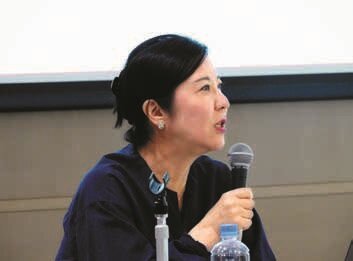
Miki Akiko
Miki Akiko
Director, Naoshima New Museum of Art/International Artistic Director, Benesse Art Site Naoshima. Former Chief and Senior curator at Palais de Tokyo(Paris, 2000-2014), Artistic Director and Director, Yokohama Triennale 2011 and 2017. Guest curator at Barbican Art Gallery, London, Taipei Fine Arts Museum, National Museum of Contemporary Art, Korea, Mori Art Museum, Tokyo, Yokohama Museum of Art, Kyoto City KYOCERA Museum of Art among others.
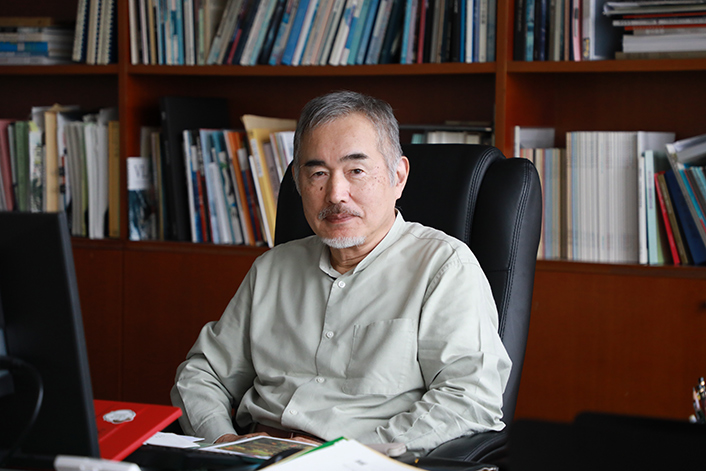
Ushiroshoji Masahiro
Ushiroshoji Masahiro
Born in May 23, 1954, in Kokura City (now Kitakyushu City), Japan
He graduated from the School of Letters at Kyushu University in 1978, majoring in aesthetics and art history, and in the same year began his career as a curator in the Preparatory Office of the Fukuoka Art Museum. As a chief curator, he played a key role in establishing the Fukuoka Asian Art Museum, which opened in 1999. He was appointed Professor at the Graduate School of Humanities, Kyushu University (2002-2020) and the President of the Kitakyushu Municipal Museum of Art in 2021. As a director at the Fukuoka Art Museum and the Fukuoka Asian Art Museum, he organized and curated exhibitions, including Asian art exhibitions and "The Birth of Modern Art in Southeast Asia : Artists and Movements 1997" contributing significantly to the introduction of modern and contemporary Asian art.